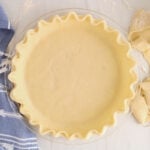
Easy Vegan Pie Crust (with Coconut Oil)
Making your own vegan pie crust is easier than you might think! Perfect for sweet vs savory pies, done using a food processor and made with coconut oil. Makes a flaky and tender pie crust that's pretty much fail-proof. Plus, no one will be able to tell it's vegan!
Servings: 2 crusts
Calories: 909kcal
Equipment
- Food processor
Ingredients
- 2 cup all-purpose flour see notes
- ½ cup refined coconut oil solid and chilled
- ½ cup cold iced water see notes
- pinch of salt
Instructions
- Start by making sure your coconut oil is solid and cold. If too soft, then measure the ½ cup you will need and chill in the fridge first.
- In a food processor, add the flour, salt and chilled coconut oil. You can scatter the oil in chunks over the flour. Then, pulse a few times to break the oil in smaller pieces.
- Then, add the iced water and keep pulsing until it looks like a moist crumbly texture. Do not over-process! It should look mostly uniform, but still very crumbly and not smooth.
- Transfer the crumbles on a lightly floured surface and use your hands to combine the dough together to the shape of a ball. Do not over-manipulate the dough, you do not want to warm up the oil! You are NOT looking to make a super smooth ball, just bring it together until combined. Then, cover the ball with cling wrap and chill in the fridge for at least 20 minutes before rolling.
- Once chilled, transfer the dough back on the lightly floured surface and cut it in half (there is enough for a bottom + a top of a pie). Then, use a rolling pin to roll the dough: start in the middle towards the edges, then repeat in a different direction. Keep going until you have a disc large enough for your pie dish (9 inches works great). The dough might crack as you roll, simply correct by using your fingers as you go. Transfer over your pie dish, fill with your favorite pie filling and bake following your recipe recommendation.
Video
Notes
- You can also use 1 cup all-purpose flour + 1 cup white whole wheat flour.
- I usually have enough of ½ cup of iced water, but if you think your dough needs more hydration (depending on how you measured the flour and the brands you used), then add ½ tablespoon of extra cold water and pulse.
- Try to work as fast as you can so the coconut oil stay cold until you bake it.
- When processing the ingredients, try to pulse instead of doing a constant process and stop whenever it looks mostly uniform, but still crumbly. You want to keep some tiny chunks of oil intact!
- Be sure to use refined coconut oil if you want to avoid a coconut oil flavor.
- Chilling the dough is essential for best texture, which will firm up slightly the texture of your ball of dough and might make it harder to roll, but that's what you are looking for.
- I did not do it here, but you might want to leave some extra dough hanging on the side until after you added your filling, especially if topping a second crust over the filling as well. This way, it gives you more crust to work with if you want to press both layers of crust together or looking to crimp your pie. Also keep in mind that the crust tends to shrink a little while baking, so some extra crust is great! I recommend you to watch this super quick video on how to crimp your pie crust for more ideas.
- Can add 1-2 tablespoons of granulated sugar to the dough if making a sweet pie.
- Nutrition: please note that the nutritional information is an estimate per serving (in this case for a whole pie crust) provided for informational purposes only (calculated by software) and accuracy is not guaranteed. Consult with your healthcare provider or a registered dietitian if you need precise nutrition calculations for health reasons.
Nutrition
Calories: 909kcal | Carbohydrates: 96g | Protein: 13g | Fat: 55g | Saturated Fat: 45g | Polyunsaturated Fat: 1g | Monounsaturated Fat: 4g | Sodium: 3mg | Potassium: 134mg | Fiber: 3g | Sugar: 0.3g | Calcium: 19mg | Iron: 6mg